Chapter 01
The Friedmann Equations
Two equations that govern the expansion of the entire universe — derived from general relativity in 1922, seven years before Hubble observed expansion. They predict everything from the Big Bang to the accelerating cosmos we see today.

The Equations
First Friedmann Equation — the expansion rate
How fast the universe expands depends on its total energy content. The left side is the square of the Hubble parameter. The right side has three terms: matter/radiation density (), spatial curvature (), and the cosmological constant ().
Second Friedmann Equation — acceleration
Does expansion speed up or slow down? Matter and radiation () decelerate expansion. The cosmological constant () accelerates it. The universe transitioned from deceleration to acceleration at redshift — about 5 billion years ago.
Density parameter form — what cosmologists actually use
Each component scales differently with the scale factor : radiation dilutes as , matter as , curvature as , and dark energy stays constant — which is why it eventually dominates.
Measured Values
| Parameter | Symbol | Value (Planck 2018) |
|---|---|---|
| Hubble constant | 67.4 ± 0.5 km/s/Mpc | |
| Matter density | 0.315 ± 0.007 | |
| Dark energy density | 0.685 ± 0.007 | |
| Radiation density | 9.1 × 10⁻⁵ | |
| Equation of state | −1.03 ± 0.03 (Planck 2018) | |
| w₀, wₐ (DESI 2024) | −0.73, −1.05 (2.5–3.9σ from Λ = const) |
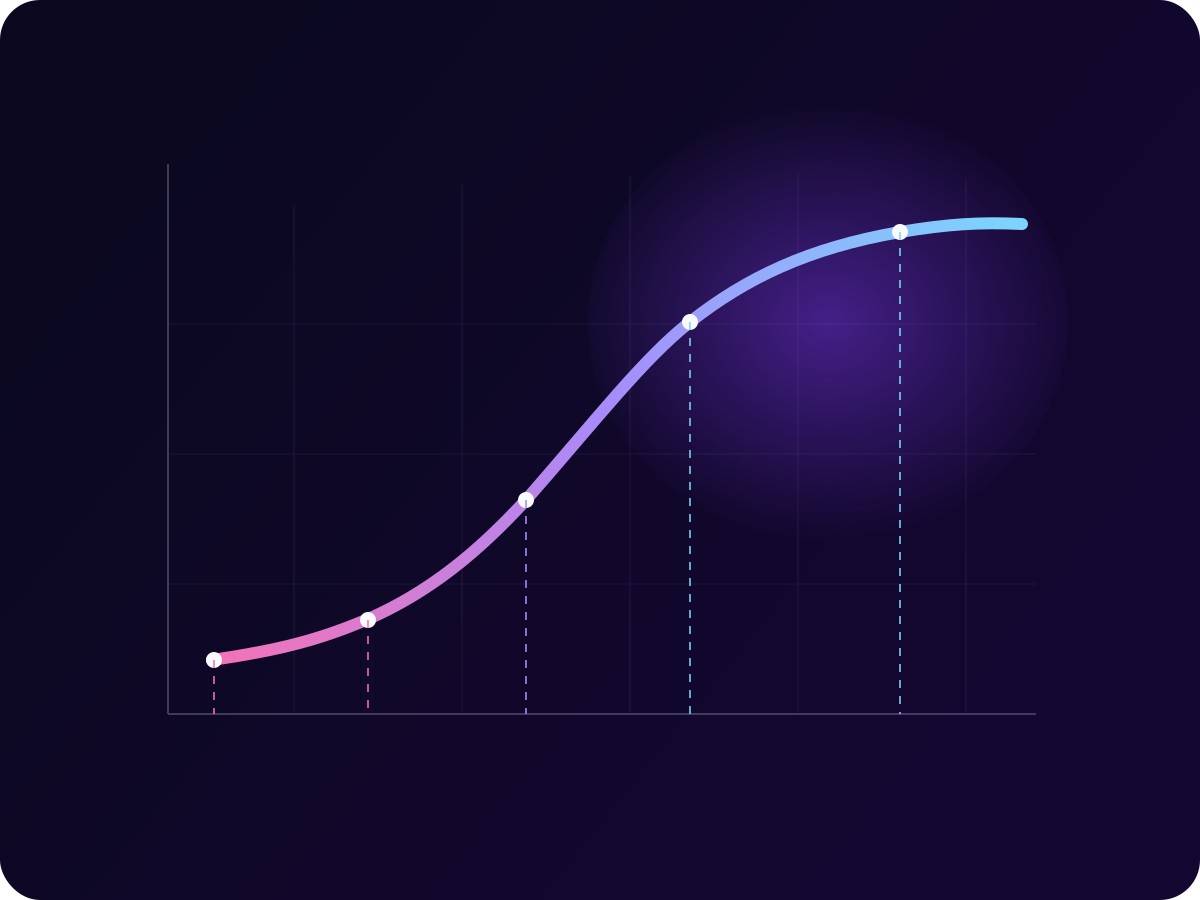
Simulation: Cosmic Expansion
200 galaxies expanding according to the Friedmann equations with Planck 2018 parameters. Toggle dark energy to see the difference — with , expansion accelerates and galaxies fly apart. Without it, expansion decelerates.
Why This Matters
The Friedmann equations are where the cosmological constant problem lives. When you write , you're saying that 68.5% of the universe is made of something we don't understand — something that makes empty space push outward.
Quantum field theory predicts that the vacuum should have energy — virtual particles popping in and out of existence contribute to . But the predicted value is times larger than what we observe. This isn't a small discrepancy. It's the worst prediction in the history of physics.
Our approach: use computation and AI to explore this problem from new angles. Simulate alternative models. Visualize what the equations describe. Find patterns that pen-and-paper derivations might miss.
The Derivation
Start with the Einstein field equations applied to a homogeneous, isotropic universe (the FLRW metric):
The FLRW metric describes a universe that looks the same in every direction and at every point:
Plug this into Einstein's equations with a perfect fluid stress-energy tensor. The component gives the first Friedmann equation. The components give the second.
The scale factor is the single dynamical variable — it tells you how much the universe has expanded relative to today ().